Venice, June 2026
13/19/32
Artist statement for the EP released on Elm records
“13/19/32″ is an album that explores the theme of delay. The work is built around the concept of a time-lag accumulator, in which layers of sound are created using delays of different lengths to produce seemingly simple yet asynchronous patterns. Contrary to what one might assume, working with delays does not mean leaving the composition up to chance. The notes played overlap in a causal manner, as the delays are entirely predictable. In abstract terms, a delay is a temporary copy of an initial sound event, repeated over time. It’s akin to a theatrical script – everything is defined from the outset and then unfolds accordingly. In this sense, it is the perception of multiple, parallel delay times that gives the impression of randomness to the listener.
This approach reflects a deterministic, causal worldview, in which what happens in the future is already contained in the present – entirely foreseeable as the consequence of a set of initial conditions. The architecture of delays behaves much like a classical mechanical system: once triggered, its elements follow a linear and calculable path. This mirrors the classical physics conception of the Universe, where every effect follows inevitably from a cause, and where, in principle, complete knowledge of the present allows one to predict the future. The delay system is thus like a Newtonian model in sound – predictable, orderly, and governed by strict temporal logic.
Yet music, and particularly live performance, resists full determinism. The act of composing in real time – responding intuitively to the layered patterns of delays – is not bound by preordained outcomes. The decision to play a note, to intervene or remain silent, often emerges from an inner space that is not fully rational nor predictable. In this sense, the creative gesture aligns more closely with the probabilistic framework of quantum mechanics, where the future is not fixed but exists as a range of possibilities, and outcomes become real only at the moment of observation or interaction. Each improvisational choice is akin to the collapse of a wave function: a singular event drawn from a field of potentialities. Here, indeterminacy is not a flaw but the vital core of the creative act.
“13/19/32″ inhabits the tension between these two dimensions, between structure and spontaneity, between mechanical repetition and human intervention. It is in this oscillation between the classical and the quantum, between the script and the improvisation, that the music finds its space to exist.
Venice, 21 November 2025
ONDA ~ PARTICELLA
Artist statement for the album released on Lᴏɴᴛᴀɴᴏ Series
Music, in its deepest essence, has always represented a means of inquiry into reality—a sensitive way of questioning the world. A way of observing, deconstructing, and reassembling reality through an imaginative lens. A reality that is never given once and for all, but instead presents itself as a process in constant flux, as a shifting appearance. Music, understood in this way, is not something separate from reality, but a transfigured emanation of it, capable of transcending it and returning it in an “other” form. Each note, each pause, originates from the observation of the world around us and proposes an alternative. In this sense, making music is undoubtedly a speculative act that moves beyond rationality, though not in opposition to it. It is a way of knowing—not through linear logic, but through intuitive thought that unfolds by resonance, analogy, and tension.
The theme of perceiving reality has always been central in the history of human thought. From ancient Greece to Eastern mysticism, to contemporary physics and neuroscience, humankind has constantly questioned what it is that we truly experience through the senses. Plato, through the allegory of the cave, showed how what we believe to be real may be only a projection; Buddhist philosophers spoke of phenomenal reality as Maya, an impermanent illusion; today, contemporary neuropsychology seems to confirm that the act of perception is not a neutral window onto the world, but an active, dynamic, and fallible construct.
In the twentieth century, with the birth of quantum mechanics, these insights found a surprising echo in physics. The double-slit experiment—originally conceived by Thomas Young in 1801 to demonstrate the wave nature of light, and later replicated with particles such as electrons by Clinton Davisson and Lester Germer in 1927—challenged the very concept of objectivity. A particle, when unobserved, behaves like a wave, generating interference patterns; but the moment one attempts to measure it, it manifests as a particle, with a definite behavior. It is as if reality exists in a multiplicity of potential states, which become concrete only upon observation.
This principle, known as “quantum superposition,” is one of the most enigmatic aspects of modern physics. In recent years, physics has attempted to go beyond this dualism by introducing the concept of the “field”—as in the Standard Model, where particles are considered local excitations of a quantum field. Yet even the “field” remains a theoretical construct, a mathematical metaphor. As Gregory Bateson would say: the map is not the territory, just as mathematics is not nature. In other words, we still do not know with certainty what the ultimate reality of matter is made of.
It is within this ontological uncertainty, this space of indeterminacy and potential, that the present reflection is situated. A composition is never merely a sound architecture, but a subjective attempt to resonate with this foundational oscillation of reality. Like quantum particles, music also exists in a state of possibility until it is played, written, or recorded. Each piece exists in potential, in the mind of the composer, as a field of probabilities—of forms, rhythms, harmonies not yet determined. Only the poetic act (from the ancient Greek “to create”) causes a collapse, a crystallization of form. Composition is thus an event of measurement: it determines one expression among many possible ones, withdrawing it from potential indeterminacy, just as happens with the wave function upon observation.
The analogy with the physics of the infinitely small is not a romantic overreach: it is a parallel that allows us to perceive how musical intuition can reflect a deep structure of the universe. Just as quantum mechanics teaches us that the world is not made of objects with fixed properties, but of probabilistic events that manifest only in relation to an observer, so too does music arise from a potential field of forms, colors, emotions—and becomes real only in the creative act.
In this light, music can be a divertissement, but in the noblest sense of the term: a serious game, an imaginative laboratory, an intuitive path to understanding. If it is true, as Heisenberg states, that “What we observe is not nature itself, but nature exposed to our method of questioning” (Physics and Philosophy, 1958), then music too can be considered a method of inquiry—albeit one without scientific pretensions.
In a universe where objectivity dissolves and matter appears as a web of possibilities, music becomes one of the keys humankind possesses to approach—not through reason, but through intuition—the ultimate substance of being. Not to say what the world is, but to celebrate its infinite possibilities.
Venice, September 2025
THE SOUND OF MARGINS
Article included in the GROUND SOCIAL FORUM book, 2025 edition
Boundaries are spaces of transition, floating territories, elusive to the rigid logic of compartmentalization. Urban margins are ephemeral by nature, destined to change, vanish, or recombine in unpredictable forms. In these liminal spaces, hybridization occurs—a process of osmosis between seemingly heterogeneous elements, a palimpsest in which the traces of the past overlay new stratifications.
The concept of a boundary, traditionally conceived as a sharp separation between distinct domains, in contemporary contexts unravels to become an interface—a space of negotiation. Already in the topography of the medieval city, and even more so in modern urban evolutions, the boundary is never a line, but a buffer zone, a site of contradiction and mediation. The idea of a city divided into functional compartments is now obsolete: industrial, residential, and commercial zones intersect in a continuum that challenges the taxonomies of late nineteenth-century urban planning.
This metamorphosis affects not only spatial organization but also the acoustic dimension. The soundscape bears witness: in marginal areas there are no indigenous sounds, only transient acoustic events that recombine according to unexpected patterns. The roar of the agricultural tractor resounds along major extra-urban roads, the trill of the thrush overlays the hum of railway power lines. Everything dissolves into an indistinct sonic fabric, a texture in which each sound refracts to create an unprecedented polyphony.
The margin is not a limit, but a device of connection, an element of welding between realities that appear to be opposed. Boundaries lose their status as perimeters to become thresholds.
Some insist that the distinctiveness of a place is defined through its identity, a kind of characteristic stamp. Today, however, identity is built through synthesis and the convergence of diverse perspectives. Here, the notion of a “soundmark” can exist only in an anti-nostalgic key, assuming a new meaning as a network of cross-references. No event exists in isolation; its significance emerges through its relationship with other elements. In the context of the soundscape, this means that no sound, and above all no listening experience, can be considered pure—it is always part of a broader set of influences, contaminations, and cross-references.
Yet this is not a loss, but an acceptance of a paradigm shift: the margin is a laboratory of hybridization, the dwelling of a genius loci that redefines itself by embracing “other” components, thereby increasing its composite complexity.
Marginal areas, then, are laboratories where the place and its topological attributes are endlessly reinvented. They teach us that identity—sonic or otherwise—does not exist in fixity, but is constructed through change. To embrace this fluidity is to abandon rigid classifications and to recognize that if the landscape is a text in perpetual rewriting, its richness exists precisely where differences meet, clash, and merge, generating new meanings and unprecedented possibilities for interpretation—and for listening—to the world around us.
Venezia, 9 Settembre 2015
SOUNDING OUT THE WATERSHED
When I was invited to take part in the artistic residency within Liminaria 2015 – #unmappingtime, I did not quite know what to expect from spending a few days in the Fortore area. Described to me as a remote inland territory of Campania, I could hardly even locate it on geographical maps, driven by that impulsive curiosity to which Google cartography almost always offers swift satisfaction.
As is well known, however, discovering a place first and foremost means understanding how one approaches it, and never more than in this case did the train journey from Venice to Benevento, and onward to the perched village of San Marco dei Cavoti, offer the curious visitor the opportunity to construct a mental map of the site, precisely through the adventurous and unhurried approach to the destination.
The Fortore, fortunately far removed from certain grim stereotypes concerning the reckless exploitation of the Campanian hinterland, instead reveals itself as a rural landscape that has escaped the capitalist logics of territorial exploitation, both by virtue of its distance from major interregional transport routes and because of the peculiar morphology of the sites it encompasses. Upon arrival, a cursory glance at the surroundings is enough to realize that the small community of San Marco dei Cavoti is backed by the Campanian Apennines—more specifically by Monte San Marco (1,007 metres above sea level), on whose pass loom those seemingly alien objects represented by the tall masts of wind turbines, sinister sentinels standing along the ridgeline.
The artistic residency
The approach I adopted for this artistic residency derives in part from my studies in urban and regional planning, with specific reference to an idea borrowed from Landscape Ecology theory, which I am still exploring. According to this theory, the landscape can be considered as composed of minimal structural units known as patches, each with specific characteristics. When patches come into contact with one another, they generate ecotones. Ecotones are considered boundary zones where elements (animal and plant life) belonging to the different original patches intermingle. An ecotone thus becomes a new unit synthesizing the main characteristics of its constituent parts. The most important property of an ecotone is that within it there is an increase in the number of species and in population density compared to the individual patches of which it constitutes a transitional area: this richness is known as the edge effect. Attempting to translate these considerations into the acoustic domain, if we similarly assume that the sound environment can be divided into minimal units, their contact will give rise to transitional areas that are richer in sounds than the individual parts from which those sounds originate.
With the support of the technical cartography produced by the Fortore Mountain Community, my research focused on the area straddling the municipalities of San Marco dei Cavoti and Baselice, in particular Monte San Marco, which on the one hand I identified as an ideal ecotonal area and, from another perspective, as an ideal watershed between the Adriatic and Tyrrhenian seas. In my wandering in search of sounds, I was accompanied not only by my wife Rachele, who provided invaluable assistance in managing the technical equipment, but also by the Liminaria staff—particularly Giuseppe, Eva, Mariagrazia and Raffaele, whom I thank sincerely—as well as by Michele Caserio, an original local guide encountered “along the way,” an inexhaustible source of anecdotes and a bearer of precise knowledge of the territory. I thus had the opportunity to collect a substantial amount of sound material, which I later presented in the form of a soundscape composition during the festival’s closing evening at the Tower Clock Museum in San Marco dei Cavoti.
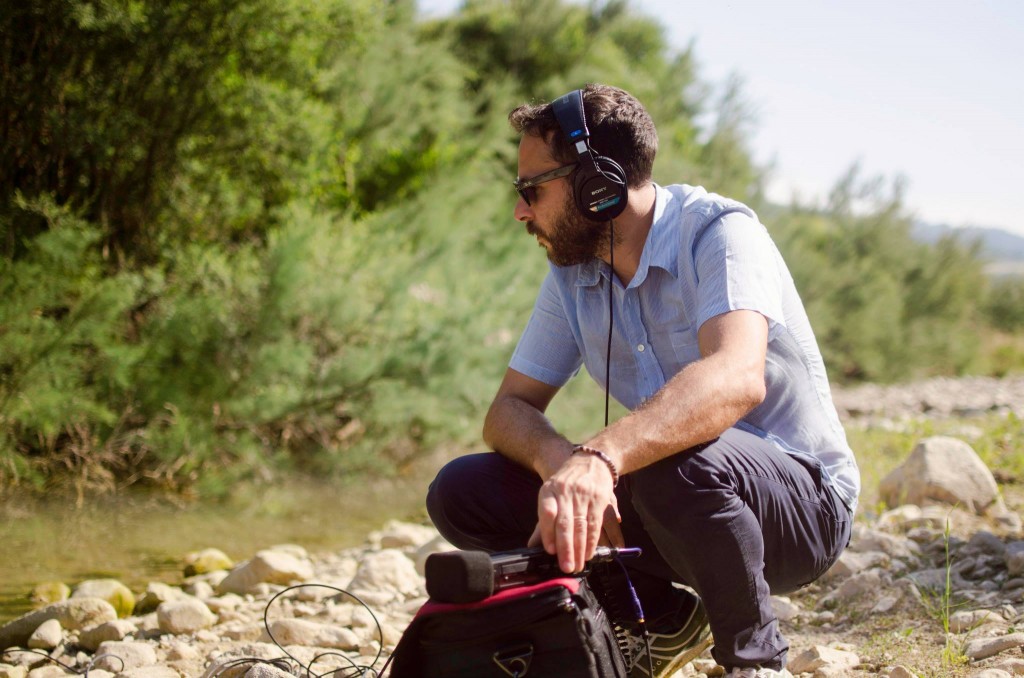
Photo by Scafando
While acknowledging that the sound environment of our geographical realities is progressively losing its traditional topophony (a synonym for Schafer’s sonic imprint), what I expected—and perhaps secretly hoped—was to uncover those elements of crisis generated by the promiscuous coexistence of conflicting land uses, such as those to which we Venetians are accustomed, living in a territory where dispersed settlement patterns and heavy infrastructural development have shredded the plain and the hills alike. Instead, I discovered that the Fortore, thanks to the geographical isolation in which it has remained confined, presents a landscape that has largely remained intact. Even today it is characterized by pronounced naturalistic features (oak and beech woods on the peri-urban fringes, the riverbed of the Fortore, for example), combined with a “gentle” human presence in the countryside.
I am referring to the agricultural practices shaping the slopes around small settlements, whose fields are measured throughout the day (it is June) by the repetitive and irregular trajectories of tractors and other small-scale mechanical vehicles. One may encounter the discordant clanging of grazing flocks and, everywhere, be enveloped by the rustling of wheat ears stirred by the ever-present wind. And speaking of wind, one suggestion can only be to place an ear against the tall pylons of the wind turbines, whose rotating blades cleave the air like measured strokes of enormous swords.
Characterizing the landscape
All of this, in my view, contributes to characterizing the Fortore’s sound environment, in the here and now of the experience to which we were led by the organizers of Liminaria. It is an imprecise attempt to explore the sonic attributes of a place, where the only true compass ultimately becomes the curiosity to discover the origin of the acoustic phenomena of the environment that surrounds us.
And so? In searching for the marginal areas of the Fortore with the eyes of an outsider, I came to understand the simple, obvious truth that the Fortore, taken as a whole, is itself a vast borderland, composed of the tesserae of a mosaic that maintains strong integrity, whose topophony stands as tangible proof of a sound environment that resists the onslaught of contemporary transformations.
With the exception of the enigmatic presence of those wind turbines—elephantine technological structures that only in the future will we be able to judge in terms of their successful, or failed, integration into the site. Yet even this contributes to identifying the genius loci, the spirit of the place, where the actions of nature and human actions together produce one of the possible landscapes of contemporary rurality.
Venice, 10 March 2015
LANDSCAPE BETWEEN FORM AND FUNCTION (PT. 2)
The objects that compose the landscape cannot be conceived merely in their individuality; that is, no object can be considered detached from its reference context. By context here we mean a delimited portion of the world on which we intend to focus our attention.
Each object thus effectively becomes a landscape element insofar as it possesses the property of being contextual in and of itself.
The composition of multiple landscape elements, linked to one another by functional relationships, gives rise to the landscape, through an evolutionary process that is not necessarily linear.
This becomes even more evident if we consider the landscape as the outcome of the processes of territorial transformation over space and time resulting from the interaction between anthropogenic and natural actions. The landscape is codified by being understood as the result of stratifying actions, which generate an overall framework that should not, however, be interpreted as a two-dimensional object of a higher order.
The visual and iconographic aspect of the landscape, which nonetheless belongs to the sphere of perception, is nothing more than the manifestation of phenomena that have deeper underlying causes. By way of metaphor, a small pond fed by underground waters is part of the hydraulic functioning system of a given territory. Likewise, a mill on the bank of a river is an engineering work that is the product of specific bodies of knowledge and cultures, since its operation refers to techniques of energy production or water exploitation for agricultural purposes, characteristic of a particular settled society.
The presence of an object is linked to its reason for being. It is not possible to consider an element of the landscape unless it is observed in relation to its raison d’être and in relation to other elements, whether similar or dissimilar.
Observing the landscape cannot be limited to the observation of forms; one must look to the substance of things, uncover uses and functions—even those that have been lost—intuit connections, and investigate underlying truths.
Venice, 1 August 2010
LANDSCAPE BETWEEN FORM AND FUNCTION (PT. 1)
Landscape is the set of aspects of a territory as perceived by humans. It is formed by an ensemble of natural and anthropogenic elements that are apprehended through their visual and relational characteristics. The primary prerogative of a landscape element is said to be that of being “visible.” This is why, historically, the scenic-visual aspect has always dominated the design-oriented approach of landscape architecture.
A fountain in a small village in Cadore, the river embankment of the Po, a row of trees in the Venetian countryside, an offshore wind farm in Sicily, the Perugia–Ancona expressway, or the so-called “eco-monsters” of the Gargano—just to name a few examples—are visible elements and therefore have some degree (small or large) of impact on landscape perception.
The nature of landscape primarily pertains to the sphere of perception. Landscape perception consists in the relationship between the observing subject and the observed object, a relationship that is likely not always univocal. Subject and object, in fact, tend to modify one another reciprocally, since the observer cannot be an element detached from the context, nor can the object be something immutable. Both indeed possess dynamic properties.
The assessment of the quality of a site’s landscape context therefore inevitably leads to considerations of a subjective nature.
There are, however, landscape elements such as forms, colors, sequences, and so forth, on the basis of which we can all arrive at a shared evaluation, even though the aesthetic taste of a given historical and cultural period, as is well known, tends to condition our judgment. When we speak of “landscape quality,” we are in fact referring first and foremost to its aesthetic quality. Everyone judges the view of a beautiful alpine meadow crossed by a stream as pleasant, but not everyone would judge in the same way the sight of a skyline bristling with skyscrapers.
Since landscape is given by the ensemble of perceived objects that compose it, and since the aesthetic evaluation of an object is subjective, even when shared, how can its quality be judged?
To move beyond this impasse, one must begin to consider the landscape not only in terms of its aesthetic characteristics, but also in terms of what is not perceived—namely, the structural and functional characteristics that have formed it, or, in other words, that have given it shape.
Form is the perceivable part of things, but the form of things is determined by the reason for their existence. In nature, the form of an element is given by its function. The perceived landscape is merely the tip of the well-known iceberg.
Venice, 5 January 2012
VENICE IS A FISH, THEY HAVE ALREADY SAID SO, BUT…
The theories in circulation are essentially two. The history of Venice is the history of a fish that attempts an adventure, that follows the imperative of the evolution of the species, of a creature that moves from the sea toward the land. Or else it is the story of a fish harpooned and dragged ashore. In any case, it is a sad story, a story of inexorable asphyxiation.
The history of Venice is the history of a métis people, composed of communities that inhabited the Venetian mainland in the fifth century. It is the story of forced migration toward a safe place, to flee the Barbarians descending from the north. A story of flight and return.
Within the nebulous expanse of the primordial lagoon, Venice took shape as a constellation of distinct settlements, among which certain centers soon emerged as particularly important. From the outset, the islands of the Venetian archipelago were in competition with one another, experiencing alternating fortunes of rise and decline. Metamauco, for instance, built along the seashore, seat of the first Ducal Palace and later destroyed by natural catastrophe. Ammiana, founded by the inhabitants of Altinum who settled in the lagoon to escape the Huns and the Lombards, later submerged behind the marshes of Torcellum. Torcellum itself, once rich and flourishing, which from the fifteenth century onward fell into decline and lost its contest with its rival Rivo Alto. History teaches us that the center of gravity progressively shifted from the seaward front toward the inner lagoon, safer and more protected. For the lagoon itself offers protection toward the mainland while opening outward to the sea.
Let us now make a vertiginous leap forward. At the height of its expansion, the Most Serene Republic of Venice dominated the Adriatic coasts and much of the Aegean islands. It asserted itself as the foremost military power and as the queen of Middle Eastern mercantile traffic. This continued until its foreseeable fall on 17 October 1797, the day on which the Treaty of Campo Formio sanctioned its end and the city surrendered to Bonaparte, when the shift of trade routes toward the Americas transformed the Adriatic into a stagnant backwater.
But let us return to the two theories. Venice is a captured fish. With the fall of Napoleon in 1814, Venice was ceded to the Austrians, who replaced the French. Ferdinand I, Emperor of Austria, decided to build a railway line between Venice and Milan, capitals of the Kingdom of Lombardy–Venetia, to connect the two cities. The new railway line, known as the Ferdinandea, was completed with the construction of a bridge crossing the lagoon to reach Venice, under the assumption that, thanks to steam traction, the city might once again compete with the ports of Trieste and Genoa in the exchange of goods with the hinterland. The inauguration of the trans-lagoon bridge in 1846 tore the fish from the marsh, hanging it on a hook from which it would be impossible to escape. The cultural landscape changed completely; habits were overturned. Until then Venice had been an island; now it became an appendage of the mainland.
Or else Venice is an evolved fish, which, in order to survive, driven by the need to change, moves toward the land. With the annexation of Veneto to Italy in 1866, Venice also regained its independence. At the end of the nineteenth century, the need emerged to find new spaces for a modern and competitive industrial port. The docks were therefore moved from the Basin of San Marco—still the historic center of Venetian port activity—to the Zattere, in the San Basilio area. But this was still not enough. Thus the Marittima was built further east, with an imposing horseshoe-shaped pier. Yet this too proved insufficient: modernity demanded more space, the scale had changed. Someone then conceived a grand idea, but looked not toward the sea, rather toward the mainland: in the Bottenighi area, on reclaimed malarial marshes, Porto Marghera would be established in 1917. Venice had cloned itself along the edge of the lagoon.
The history of Venice over the last two centuries has been marked by the polarization of the city toward that great magnet which is the mainland, the world. With a wave of the wand by the illustrious Count Giuseppe Volpi di Misurata—promoter of Italian capitalism under Mussolini, also known as the last Doge—mechanical and electrometallurgical industries arrived. Much later came the chemical industry. And with industry, where there had been only countryside, the urban district of Marghera was built, conceived as a reservoir of labor power and only partially successful in its mission, for reasons beyond the scope of these reflections. In support of the production cycle came Mestre, a small village of a few houses overwhelmed by the development of a city aspiring to novelty.
In 1933 the new road bridge was inaugurated, flanking the railway bridge. Mestre and Marghera soon became lands of exiles, when work and housing were lacking and the City of the Doges had already begun its transformation into an open-air museum. Yet these are not mere peripheries, not urban sprawl, but lands of colonization. They are the result of a Venice attempting a leap, seeking to survive itself—fruits of that destiny which was a return to the land, since the glorious past had become only a faded memory.
The complexity of the Venetian territory is the result of the complexity of relationships among the nodes of the great land–water system it has always been. A system composed of signs and spaces, vast liquid expanses, continuities and discontinuities of island and marginal fronts; of architectures, complexes, and infrastructures that attest to the history and technical knowledge of a civilization born on the sea and later rendered amphibious.
For Venice is not only the Historic City, but the ensemble of nodes that compose the system—nodes of a system that today no longer manages to “function as a system.” Parts that do not even compete, that communicate poorly and survive only weakly.
In this universe the arrow of time cannot be reversed. Venice, compelled to return to the land or betrayed by its own instinct, burdened with an inheritance too heavy to bear, drags itself uncertainly toward tomorrow. The two theories ultimately recount the same story. And this story has a single ending. Venice dies like a fish out of water on the arid shore of an alien world. Its funeral is celebrated by the thousands of people who every day flock from all over the world to honor its remains.
G. Ernesti, Venice, Guide to the Port, Marsilio, 2001;
M. Isnenghi and S. Wolf, The Nineteenth and Twentieth Centuries, History of Venice, Istituto della Enciclopedia Italiana, Rome, 2002;
A. F. Nappi, History of Marghera: From Periphery to City, Centro Sportivo Culturale, Marghera, 1994;
G. Ortalli, G. Scarabello, A Brief History of Venice, Pacini Editore, 1990;
F. Piva, Peasants in the Factory: The Case of Marghera, 1920–1945, Edizioni Lavoro, Rome, 1991;
L. Scano, Venice: Land and Water, Edizioni delle Autonomie, Rome, 1985;
G. Zucconi, Greater Venice: An Incomplete Metropolis between the Nineteenth and Twentieth Centuries, Marsilio Editori, 2002;
A. Zorzi, The Republic of the Lion: A History of Venice, Euroclub, Milan, 2001;
History of Venice, Treccani, 12 vols., 1990–2002.
Venice, 7 November 2010
TOPOPHONIES VOL. 2
Which season. Autumn. The season of aches and ailments of the spirit. The season of orange sunsets sinking over the mainland and yellow leaves falling in enclosed gardens. Autumn. When loves are heavy coats soaked with fog, or small hearths with which to warm evenings that grow dark, quickly.
Which Venice (pt. 1). Venice that sinks, a city with an admission ticket. This ancient flooded shopping mall that never closes. Venice that gives, every day, every month, every season, both the worst and the best of itself. Venice that smells of roasted chestnuts and fried fish. Venice that reeks of low tide. That gleams with colors, ready to be lost in the icy November sky. That floats and that sinks. That sleeps in the embrace of its muddy bed.
Which Venice (pt. 2). There are two Venices: the one above and the one below. The one above is the realm of the picturesque sold cheaply on stalls for tourists; the one below is the realm of sewers opening along the exposed gums of the canals.
Us. We are invisible, we live in the basement. We do not exist. We are the wind sweeping the salt marsh, but you cannot hear us. We are the drop that plunges into the boathouse, but you cannot hear us. We are the crabs whispering, clinging to the banks, but you cannot hear us. You cannot listen to our music. We inhabit two different Venices.
What is to be done. Nothing remains but to live in an imaginary city, for as long as the game holds, dangerously suspended between reality and imagination. Until we are forced into the Choice: to leave or to stay. To leave, obviously. And to stay—for what? Perhaps to stay afloat? Perhaps to let oneself sink? …?
Some remain in order to row against the current, because surrendering to the flow is something they simply cannot do.
Venice, 1 August 2008
MUSIC OF THE MARGINAL AREAS
As the New York photographer Charles Pratt once argued (1), the edges of the city are interesting precisely because they are uncertain—because their existence is uncertain, as they continuously move and transform, and because tomorrow they may no longer exist. By definition, edges are places of transition, of boundaries between domains, areas, or regions. They are sites of passage between different landscapes and thus give rise to contamination.
The limit is the place of contamination, where elements from areas that are assumed to possess their own peculiarities meet and generate dissonances.
It is no longer easy, in our cities or in our countryside, to find “authentic” soundscapes, that is, what can properly be called true “topophonies,” Schafer’s (2) term for the characteristic sound imprint of a place—meaning the set of indigenous sounds that belong to a given location. Because the indigenous often becomes, sooner or later, alien. Contemporary soundscapes are therefore spurious.
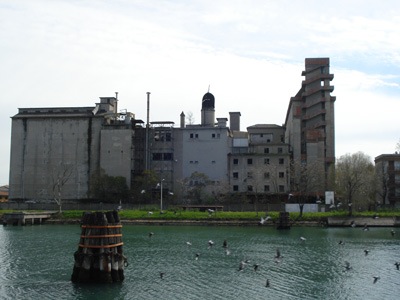
It is also difficult to isolate certain sounds as “pure,” that is, unique to their place of origin. If the city is already a melting pot of all the sounds of the world, the countryside—now distant from Olmi’s pastoral dream in L’Albero degli Zoccoli—suffers a similar fate. The sound of a combine harvester mixes with the Doppler of cars along the highway: the urban, with its uncertain borders, spills over into the extra-urban, whose boundaries are indefinable, exporting functions that have little to do with the agricultural heritage of our ancestors.
In the same way, reasoning today about a city of zoning—that is, a city divided into distinct urban functions, as everyone agrees—is no longer particularly meaningful. Shifting the focus to the soundscape, it is evident that there are no longer any hermetically sealed sonic landscapes. There is no catalog anymore of “city sounds,” “countryside sounds,” “nature sounds,” or “human sounds,” because everything has progressively blended into everything else.
The edge is the meeting place of different soundscapes. Consider, for example, the soundscape of an industrial area: we expect the roar of furnace turbines, the incessant pounding, the hissing and screeching of machines in operation. In our imagination, there is the Fordist factory; there is Chaplin grappling with the monstrous gears of basic mechanical industry. But is it only that?
If we walk in spring along the industrial canals of Porto Marghera, we notice that behind the uniform background noise of industrial activity, behind the clamor, the crashes and splashes, there is the gentle lapping of water, birds chirping from the trees along the canal embankments, along the service tracks that run through the docks, from the roofs of abandoned buildings, and from the loading cranes. Today, all industrial zones contain large abandoned spaces. Behind disused plants, for instance, vast concrete yards are recolonized by patches of grass, poppies, and fig trees. Interstices and gaps are colonized by birds and small mammals. To the supposed artificiality is added a pioneering naturalness, creating a sound context apparently at odds with the imagined “topophony” of the site, yet proving that even the most indigenous landscape leaves wide margins for sounds not directly attributable to it.
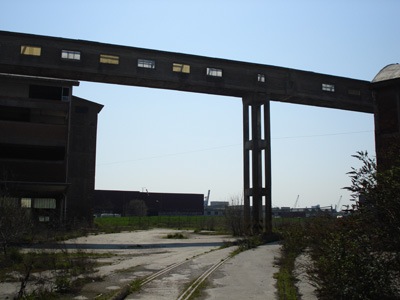
Ambient music as a “portrait of a landscape”—intended to musically represent the imaginary or real landscape of a given place (3)—cannot be limited to a topophonic representation without considering the disruptions suffered by the traditional landscape. This reveals the limits of a nostalgic vision of nature, of lost soundscapes, of the desolate northern plains or equatorial forests. If contemporary soundscape reflects the contemporary landscape, then the dispersal of settlements, the so-called “diffuse city” typical of Veneto, and the formation of a reticular territory made of scattered, drifting polarities, have generated uncertainty—uncertainty in the spatial, functional, and social comprehension of places. We are no longer certain what constitutes the city, where it ends, where the “something else” we generically call extra-urban begins, which is neither countryside nor merely non-place (M. Augé).
Everything is margin. Everything is an unstable boundary. Everything is in rapid transformation—not, alas, due to the famous Heraclitean aphorism, but because these are the rules of the market, and because territorial transformations often occur independently of any attempt at planning, regulating growth, or directing development in an orderly manner.
If, therefore, the traditional nineteenth-century opposition between city and countryside is denied, and if the boundary is no longer a geographic line implying a clear division of domains, a new concept of the margin emerges as a category of interpretation: no longer delimiting, but interfacing the different tesserae of the territorial mosaic. Areas at the margins, close to boundaries, are themselves boundary areas: they are not perimeters, but thresholds, passages, spaces of migration.
In the case of Venice, there is no discontinuity between the lagoon landscape and the industrial landscape of Porto Marghera. There is no barrier between Venice and the mainland; water no longer substitutes for the walls of the medieval castle. There is no quiet of the salt marsh without the roar of motorboats. There is no cry of seagulls without the thunder of departing planes from Tessera airport.
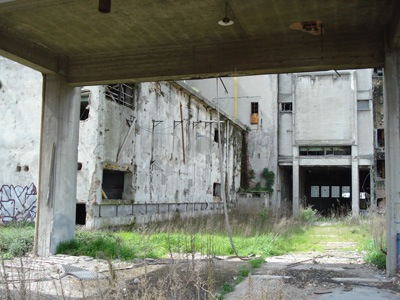
It follows that, in representing places through music, it is difficult to isolate “perfect topophonies,” and that the peculiarity of places, where the sound imprint has been definitively lost, is given by the amalgam of soundscapes to which they are in some way related. Marginal areas are dynamic spaces, of conflict, contradiction, and mediation, where the apparent strangeness of certain sounds, the apparent incoherence, becomes the new peculiarity.
(1) “I find myself drawn to [the] edges with a sense of urgency, knowing that they may be gone tomorrow—not just extended but really, finally gone,” The Edge of the City: Words and Photographs, Charles Pratt.
(2) The sound imprint is the characteristic sound of an area. “Once a sound imprint has been identified, it deserves protection, because soundmarks make the acoustic life of a community unique” (M. Schafer).
(3) A soundscape composition is an electroacoustic musical composition creating a sonic portrait of an acoustic environment (M. Schafer).
Venice, 1 July 2008
NOTES
(a manifesto)
I am interested in music as atmosphere.
Not as function.
Not as service.
Not as background.
I do not make music for times of day.
Not to accompany activities.
Not to adapt to circumstances.
No music “for”.
No catalog of moods.
My music has nothing to do with furniture music.
It does not decorate.
It does not fill gaps.
It does not optimize experience.
I think of ambient music as space.
A virtual room.
A mental chamber.
A place for thought.
An environment to inhabit.
Music as active imagination.
Music as a novel without plot.
Music as a film unfolding behind closed eyes.
I have always sought a music that can act on its own.
Without auxiliaries.
Without instructions.
A music capable of altering states of consciousness.
Not to escape, but to displace.
To make perception other.
A music that suspends the present tense.
That slips sideways out of contingency.
That opens a parallel reality—
fragile, temporary.
My addressee is the mental traveler.
Those who listen in order to get lost.
Those who move without seeking destinations.
Within a real, lived soundscape, ambient music is unnecessary.
The environment is already music.
The information is already there.
Layered.
Complex.
All that is required is listening.
All that is required is to open the ears.
Venice, 6 March 2008
MENTAL LANDSCAPES
Ambient music can be a “landscape photograph.” Representing a place through music is not simply a detailed description of its features; it is not the arrangement of its elements on the sonic stage or along the axis of time. Rather, it is the imaginary transposition of these elements into a mental horizon, forming a space of variable dimensions.
Music is tied to objective time—the ticking of seconds on a CD player—but it opens onto a sense of time that cannot be measured. One could say it travels on two parallel tracks: one straight and predetermined, the other meandering and circuitous, yet always bound to the first.
When taking a photograph, we like to think we capture the impressions we feel before things. Yet when that image passes to another, if its form remains unchanged, its substance inevitably shifts. Music, perhaps all art, belongs to us only relatively—that is, subjectively.
The architect loses control over the buildings he designs, the painter over his canvases, the craftsman over his objects, and so on. This happens because the work generates impressions in others that are entirely unexpected, often contrary to the demiurgic intentions of its creator.
In the same way, the musician loses control over his music. How much of what I intended reaches others? How much of the original idea dissipates along the way? The baton passes from hand to hand: the form remains constant, yet the succession evokes different visions of triumph.
When I take a “landscape photograph,” I aim not to capture images, but personal impressions. I take the photograph in reverse. I try to photograph the exterior, yet I am photographing myself looking at the world—a kind of self-portrait projected onto reality.
It follows that the landscape is, in some sense, always anthropomorphic. There is no other way. If a landscape exists objectively, a “landscape photograph” is a mental photograph. It cannot be shown to others without, in its supposed invariance, changing in substance. For it is we who determine the essence of things, according to the resonance they produce within us.
Venice, November 2006
THE PULSE OF THE BLUE ALGAE
There is no doubt that ambient music has, in its own way, subverted the basic rules of traditional song. The obsolete structure of verses and choruses ceases to be the universal reference. Singing, melody, recede into what functions as “background,” which now becomes the true protagonist on stage. In the sonic landscape, what is foregrounded can move to the background, and vice versa. The new melody—slow, not necessarily melodic, not necessarily tonal—is the ambience itself. The soundscape becomes the object of attention—or of non-attention—of the listener.
The rhythm of ambient music is the pulse of the blue algae.
The distant roar of passing storms, the freshness of cicadas chirping in the countryside, the dark rumble of the city and industry—these are the new melodies. The many songs of an “artificed” reality, filtered, elaborated, recorded, or synthesized by the musician—or non-musician—become the music.
This music, oscillating between degrees of distance from the schemes and references of “ordinary” music—more or less abstract, more or less electronic, more or less concrete—demands attention or non-attention, according to the will of the composer, but above all according to the will of the listener. It is up to the listener to decide how to engage with it: as background, or with focused concentration.
Ambient music requires patience. There is no chorus to wait for, no moment of “catchiness” to satisfy. It offers a world to float in without obvious references. Yet, if one listens closely, the references are there—different schemes, different symbols, different elements. Those in a hurry will change the disc.
The journey is initiatory. Space and time expand and lose their conventional meaning. One must carve out a dedicated time for listening, like a daily therapy, an exercise. To truly listen to ambient music, one must follow its rules, where time and space are regulated differently in each piece, creating self-contained universes.
Venice, September 2006
ROOTING
We are ambient music, music to tell Venice—its physical and mental landscapes—from an unconventional point of view: emotional, surreal, nostalgic, futuristic, catastrophic. Traversing languages unfamiliar to most, we embrace this legacy with a gentle sense of responsibility.
WHICH VENICE
Venice is the primary source of inspiration for my music—but not the Venice everyone knows. Not the Venice that ends at Piazza San Marco, behind which nothing exists. Not Vivaldi’s Venice, not the Venice of Carnival grandeur, the Biennale, the Regata Storica, or the Film Festival. Not the Venice of hotels and restaurants, not the Venice packaged for the world on postcards: romantic, gloomy, decadent, or sumptuous, ready to sell in tourist brochures.
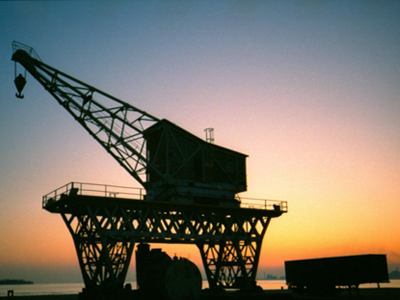
The other city is industrial: the Mulino Stucky, a massive Gothic fortress rising over the Giudecca Canal; the sad face of Sacca Fisola, its old incinerator mirrored gray on the lagoon; the “casermette” at Celestia, sheltered by the Arsenal’s severe walls; Santa Marta with its public housing, the steel frames of former gasometers; the rusted quays of the old maritime port, its dormant cranes.
It is the Marghera skyline, crouched and threatening across the lagoon, its industrial port, chimneys, deserted warehouses; the terrain vague and that enchanted garden of a probably mistaken fairy tale; Mestre, a Fordist city, faded 1950s neighborhoods, dead railway tracks and stations; modernist architecture of little merit, towers, materials.
It is the lagoon islands, Burano’s naïve charm, the infectious disease hospital at Grazie, the psychiatric hospital on Sacca Sessola; the barene, the tidal flats behind Sant’Erasmo, the outer piers with their lighthouses shot out to sea, the wind-swept dunes of the Lido; the lagoon plain, sometimes a bright blue mirror, sometimes a dark stagnant pond, seemingly lifeless.
It is Venice at sunset, from the Zattere, Fondamenta Nuove, or the Pellestrina waterfront; Venice of boats and foggy nights, of the mainland lighting the horizon with orange glow; of the smell of fuel, of wisteria in spring, ozone in autumn. It is Venice of lonely campielli, blind alleys, dark courtyards, stray cats living in colonies, and clever rats ruling the night. It is the Venice of intimacy, of childhood games and love.
It is the Venice of dreams: disordered, dismantled, and rebuilt a thousand times; of colossal drunkenness and nocturnal adventures. Venice with altered proportions, pastel colors, arabesques fading across every surface, water or stone alike. Venice of the fantastic, of our reckless adolescence.
And then, there is Venice as theme park, the Disneyfication of everyday life, a city that empties and dies. A distant future in which it may sink into a mire, or be claimed by the surges of the sea.
TERRAIN VAGUE AND VIRUS AREA
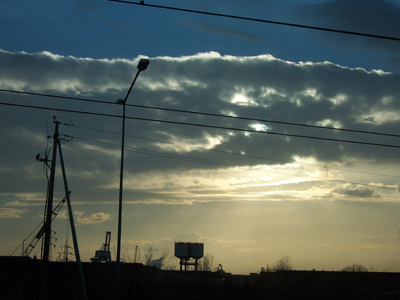
Terrain Vague. Space abandoned, external, alien; residual areas at the city’s edge or sudden urban voids; the effect of a city evolving indeterminately, unpredictable for the future.
The passage from a terrain vague to a virus area transforms a neglected place into something that escapes the all-encompassing will of planning, its identity shaped spontaneously, oriented toward temporary and unspecified uses of space.
Virus Area. In metaphor, something that stretches its tentacles around neighborhoods, streets, houses. Something that spreads beneath the skin, quietly merging with its host.
STALKING VENICE
The English verb to stalk, literally “approach cautiously,” has acquired a broader meaning: to explore as Tarkovskij described in his famous film Stalker—to approach a goal with care, following capricious paths, where getting lost, wandering, and digressing become, in themselves, the purpose of the journey.
The “room of wishes” remains, in the end, inviolate.
Explore what? Urban spaces on the margins, abandoned or transforming industrial zones, terrain vagues, virus areas… the “dark matter” of urban systems, the crippled limb of the functional city.
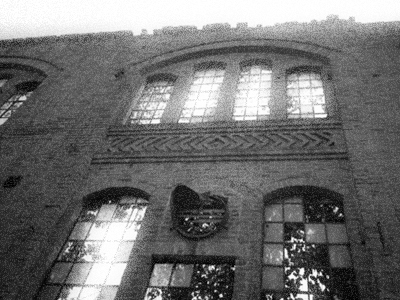
Many years ago we began wandering through the unknown parts of Venice, abandoning habits, unhurried. We discovered traces of a paleo-modern city, degraded yet unexpectedly fascinating, awakening in us a curious desire to experience unusual landscapes and new states of mind. Unsafe, alien, arcane zones—from the lagoon’s fringe to the heart of industrial Marghera. On foot or by bike, always a step from home, door left ajar, we ventured into twilight places, seeking something we could not yet name. We mingled dreams with reality, reconstructing in our memories the profile of a new, finally original city.
Every exploration requires caution: what we seek does not reveal itself easily, as Tarkovskij suggests. And though the results are often the most ephemeral part of the quest, we still gathered countless treasures along the way.
The purpose of going is simply going.
“Stalking Venice” is the title of a potential manifesto, an invitation, for those willing, to undertake the path of stalking—through Venice, and wherever we find ourselves. Toward a new way of inhabiting, a new way of being a tourist.
Venice, January 2006
MUSIC AS CREATIVE IMAGINATION
Creative imagination, yearning, desire.
To dwell in light, to live in lightness. In the world of theophanies—literally, where the god manifests.
Can music be a discipline, a path toward a sort of agnostic mysticism?
The search for a new harmonic sequence, a new composition, is driven by an insatiable thirst for truth.
Perhaps it is the quest for that “Break in the Wall,” as Aldous Huxley cites the poet William Blake, within the world of Transcendental Experience (A. Huxley, The Doors of Perception).
In this sense, music can be an expressive path for creative imagination—a means to approach the divine. From the sensible world to the supersensible, where and when the truths to which humankind has always, by inescapable nature, tended, will be revealed.
Venice, April 2005
AIMS
One of the first questions I asked myself when I began exploring ambient music was whether music—any music—belongs to the here and now, or rather to the indefinite, other dimension of elsewhere. If we were to accept the latter hypothesis from the outset, music would function solely as a medium, a vehicle mediating between the contingent reality and an otherness—temporal and spatial—thus referring the listener to that other realm. While this is plausible, it is also a somewhat reductive conception. Music, considered as reproduced sound, is undeniably a technological marvel, capable of abstracting the listener from context and evoking something that tangibly belongs neither to place nor to time—and therefore entirely subjective in the emotions it provokes.
Yet music possesses dignity in itself, and its purpose cannot be exhausted merely as a vehicle of escape. Returning to the first hypothesis, we cannot deny that music exists in the moment, in the concreteness to which it belongs. It does not merely recount something that has already happened, nor something that will never occur; it describes places in the present, decorates them, even “determines space.” Even when ignored, or reduced to a uniform background murmur, music enriches the present without ever canceling it. Thus, just as music often evokes distant times and places, it also speaks softly of the here and now, helping us focus on it, comment on it, or place it against the backdrop of that elsewhere without which our daily experiences seem insufficiently validated. Ambient music, in our view, is precisely the form that best reconciles this apparent contradiction—continuously bridging moments of escape with moments of reflection, alienation with reconciliation. For flight and return, in abstraction, are inseparable; in every instant, to flee also means to return.
At the twilight of modernity, as the modern city emerged, nature was progressively removed from daily experience, confined within garden gates, parks, and the realm of myth—and therefore of nostalgia. With the rise of mass society came the need to escape—from the city, from work, from routine—giving birth to the myth of the weekend, the theme park, the exotic vacation. In this sense, ambient music is for us that garden: a space where nature has been gradually enclosed, tamed, or, in Leopardi’s words, “artificiata.”
Yet a garden can never provide the full experience of nature, for it is only a fragment of it. Likewise, ambient music cannot fully replicate the experience of environment or landscape (assuming that a given piece of ambient music evokes a sensual or virtual sense of place), but it can always offer a realistic—even if partial—experience of it. Ambient music is, for us, like an in vitro botanical reserve: a collection of countless subcellular fragments from which, at any moment, the original forms can be reconstructed.
Listening to music can never replace a walk by the sea if one is confined to a hospital room, yet it does not pretend to do so. Music is not a panacea; it does not swallow reality. Instead, it allows reflection, providing clues to evoke a larger reality. Ambient music can today restore a proper relationship between humans and their environment, cultivating attentive listening—to oneself and to others.
“True tradition is not a testimony of a concluded past, but a living force that animates and informs the present.”
—Igor Stravinsky, Poetics of Music
Those who undertake this path of devotion to music that speaks of elsewhere, while maintaining engagement with the here and now, must begin with the present and with understanding the context. I am convinced that one’s creative output is always “singular,” yet it can and should be understood as a synesthetic synthesis of the labors of other creative talents. One cannot ignore the work of those who, before us, explored the possible, creating paradigms from which our modest efforts must start.
My own creative journey can be seen as a constellation of experiences—varied, fragmented, sometimes contradictory—but looking back, one perceives strong threads of continuity, repetitions, or at best, variations on a theme. This continuity manifests in the recurring structural choices I make, shaped both by my frequent engagement with certain authors and by the profound admiration I hold for them. One might say that it is impossible to offer an entirely original contribution until we emancipate ourselves from our references; yet research, conceived as the continuous proliferation of escape routes, interaction of knowledge and experience, and a personal approach to observing reality, inevitably leads to the construction of an “original” path. With due caution regarding the term, it is the path itself—not its outcome—that proves the inherent success of research.
